The Entrepreneurs Paradox
Drawing on nearly three decades of working between entrepreneurs and capital, Dr. Zarif Menon unpacks the paradox at the heart of business growth.
Dr. Zarif Menon
6/27/20265 min read
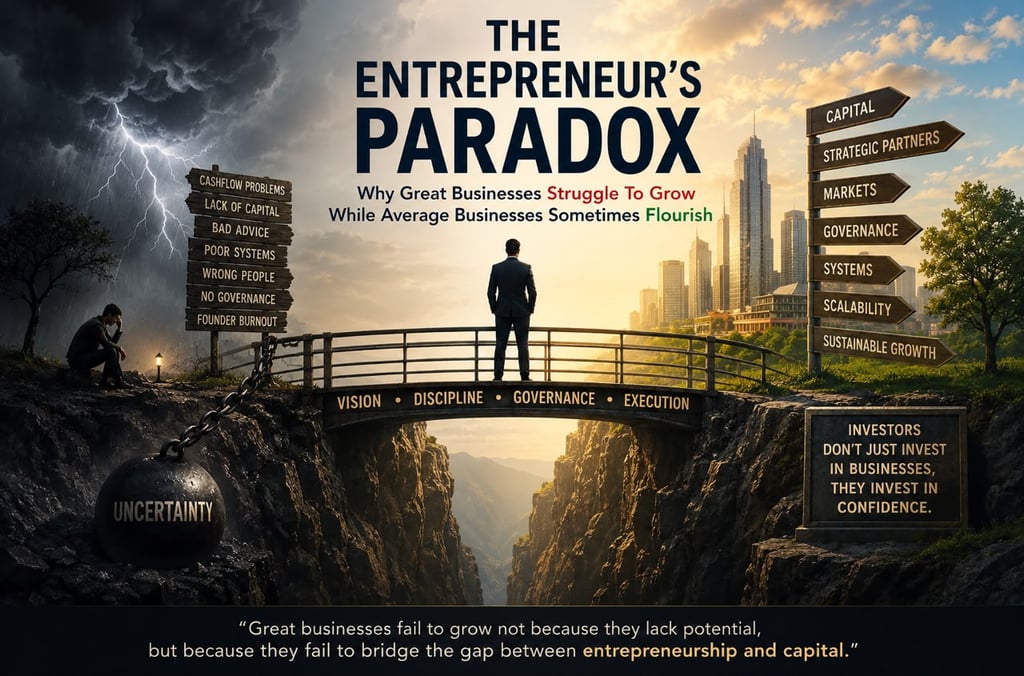
Why Great Businesses Struggle To Grow While Average Businesses Sometimes Flourish
The Elite Expanded Edition By Dr. Zarif Menon
Entrepreneur • Strategist • Capital Advisory Practitioner
PART 1 – THE ROMANCE OF ENTREPRENEURSHIP
There is something profoundly beautiful about entrepreneurship. Every business that exists today once existed only in the imagination of one individual who believed that the future could be different from the present.
Having spent almost three decades working with entrepreneurs since 1998, I have discovered that almost every founder begins with the same ingredients: optimism, conviction and hope. They do not begin with governance manuals, audited financial statements or institutional reporting frameworks. They begin with belief.
The entrepreneur sees possibilities where others see obstacles. This ability to visualise a future that does not yet exist is perhaps the entrepreneur's greatest strength. Ironically, it can also become one of the entrepreneur's greatest vulnerabilities because markets reward execution rather than aspiration.
Customers buy value. Investors buy confidence. Banks lend against evidence. Markets reward outcomes rather than effort.
One of the earliest lessons every entrepreneur eventually learns is that the marketplace is remarkably indifferent to sacrifice. It does not measure sleepless nights, personal guarantees, family sacrifices or emotional investment. It asks only one question: does the business create value consistently enough for customers to continue paying for it?
Understanding that distinction marks the transition from dreamer to entrepreneur and eventually from entrepreneur to enterprise builder.
PART 2 – THE FIRST FIVE YEARS
The first five years are often portrayed as exciting and glamorous. My own observations suggest something very different.
The first five years are usually a test of endurance.
The overwhelming majority of businesses that disappear do not disappear because they lacked intelligence or ambition. They disappear because they underestimated cashflow requirements, overestimated growth and underestimated complexity.
Revenue and cashflow are not the same thing. A company can report millions in annual turnover and still fail because salaries, taxes, suppliers and financing obligations require cash rather than invoices.
The second challenge is undercapitalisation. Nearly every entrepreneur believes the project will cost less, take less time and scale more quickly than reality eventually permits.
The third challenge is people. Products can be improved and markets can change, but poor hiring decisions often create damage that can take years to reverse.
Finally comes founder exhaustion. Entrepreneurs become salespeople, negotiators, accountants, strategists and crisis managers simultaneously. Very few outside the entrepreneurial community fully appreciate the emotional weight that accompanies that responsibility.
PART 3 – SURVIVING SUCCESS
One of the greatest ironies in business is that growth itself can become a threat.
A founder who successfully manages a RM2 million business may struggle with a RM20 million enterprise because scaling requires entirely different disciplines.
Informal communication becomes inadequate. Informal approvals become dangerous. Founder intuition becomes insufficient.
Many businesses become trapped in a dangerous middle ground: too large to remain informal and too informal to become institutional.
This is where governance ceases to become bureaucracy and instead becomes scalability.
Processes create consistency.
Reporting creates visibility.
Delegation creates capacity.
Governance creates confidence.
Sophisticated capital does not invest in personality alone. It invests in systems capable of surviving beyond the founder.
PART 4 – TWENTY-EIGHT YEARS BETWEEN ENTREPRENEURS AND CAPITAL
When I entered business advisory and capital facilitation in 1998, I believed the greatest challenge facing entrepreneurs was access to money.
After twenty-eight years working with family offices, institutions, investors, entrepreneurs and governments across multiple jurisdictions, I eventually reached a very different conclusion.
Money was rarely the primary problem.
Preparation was.
Across manufacturing, healthcare, education, plantations, logistics, technology, property and energy, the same pattern repeated itself.
Entrepreneurs saw opportunity.
Investors saw risk.
Entrepreneurs saw tomorrow.
Investors saw downside exposure.
The difference was rarely intelligence or integrity. The difference was perspective.
Bridging that gap became one of the defining missions of my professional life.
PART 5 – THE FOUNDER MINDSET PROBLEM
Confidence creates businesses. Without confidence there would be no entrepreneurship.
However, confidence can slowly evolve into assumption, entitlement and occasionally arrogance.
One of the most common statements I hear is that investors should be interested because the business is already successful.
Investors do not compare opportunities against the entrepreneur's expectations. They compare them against hundreds of alternatives competing for the same capital.
Entrepreneurs ask how much can be raised.
Investors ask how much can be lost.
Entrepreneurs price sacrifice.
Investors price risk.
Understanding this distinction changes capital conversations entirely and often determines whether a funding exercise succeeds or fails.
PART 6 – THE BIRTH OF PAG
These observations eventually led to the formation of Pacific Alliance Group.
The vision was simple but ambitious: create an organisation capable of helping entrepreneurs understand capital and helping capital understand entrepreneurs.
Over time it became increasingly clear that introductions alone were insufficient.
Businesses required governance.
Businesses required structure.
Businesses required institutional discipline.
Businesses required preparation.
Together with trusted colleagues and strategic partners, the organisation gradually evolved into an ecosystem focused on transformation rather than transaction.
The objective was never merely to find money.
The objective was to help businesses become worthy of institutional confidence.
PART 7 – THE PAG ECOSYSTEM
Business problems rarely exist in isolation.
Capital challenges often reveal governance weaknesses.
Governance weaknesses reveal structural weaknesses.
Structural weaknesses reveal strategic weaknesses.
This repeated pattern eventually led to the development of an ecosystem rather than a consultancy.
The ecosystem was designed to evolve alongside the entrepreneur and the enterprise itself.
Every capability that exists today emerged because a real business faced a real problem requiring a practical solution.
PART 8 – THE MISSING BRIDGE
After almost three decades, one conclusion became impossible to ignore.
The world is not suffering from a shortage of money.
The world is suffering from a shortage of businesses prepared to receive it.
Many businesses are viable.
Far fewer are investable.
Many businesses can survive.
Far fewer can scale institutionally.
The difference almost always lies in governance, visibility, management depth, succession planning and risk management.
Capital does not avoid businesses.
Capital avoids uncertainty.
PART 9 – FINAL REFLECTION
Entrepreneurship will always require courage.
It takes courage to risk savings, reputation and certainty in pursuit of something that may never exist.
Entrepreneurs deserve respect for that courage.
However, courage alone has never guaranteed success.
The modern business environment rewards preparation, transparency and discipline more than ever before.
If there is one lesson I hope entrepreneurs take from my own journey since 1998, it is this: Do not ask why capital avoids your business.
Ask instead what your business must become in order to deserve confidence.
That single question has the power to transform an enterprise.
After twenty-eight years standing between entrepreneurs and capital providers, I remain optimistic.
The opportunity still exists.
The future remains bright.
But the future belongs to the prepared.
Dr. Zarif Menon
"Building bridges between ambition and opportunity since 1998."
Dr. Zarif Menon is an entrepreneur, strategist and capital advisory practitioner with almost three decades of experience advising entrepreneurs, family offices, investors and institutions across multiple jurisdictions including Malaysia, Australia, Indonesia, the United Kingdom and the Middle East. His work focuses on governance, capital readiness, strategic structuring and building bridges between entrepreneurs and institutional capital.
Twenty-Eight Years Of Observations Standing Between Entrepreneurs And Capital (1998–2026)
Contact
Phone
admin@zarifmenon.com
admin@pacificalliancegroup.my
+44 7888 438570 (UK)
+60 16 666 7898 (Malaysia)
+62 877 7999 7898 (Indonesia)
© 2026. All rights reserved.