Business Ethics - Truth or Fiction?
Drawing on an entrepreneur's perspective, Dr Zarif Menon examines the dangers of blind belief and blind skepticism, the role of governance as a competitive advantage, and why evidence, not appearances, is the real foundation of credibility.
Dr Zarif Menon
6/22/20264 min read
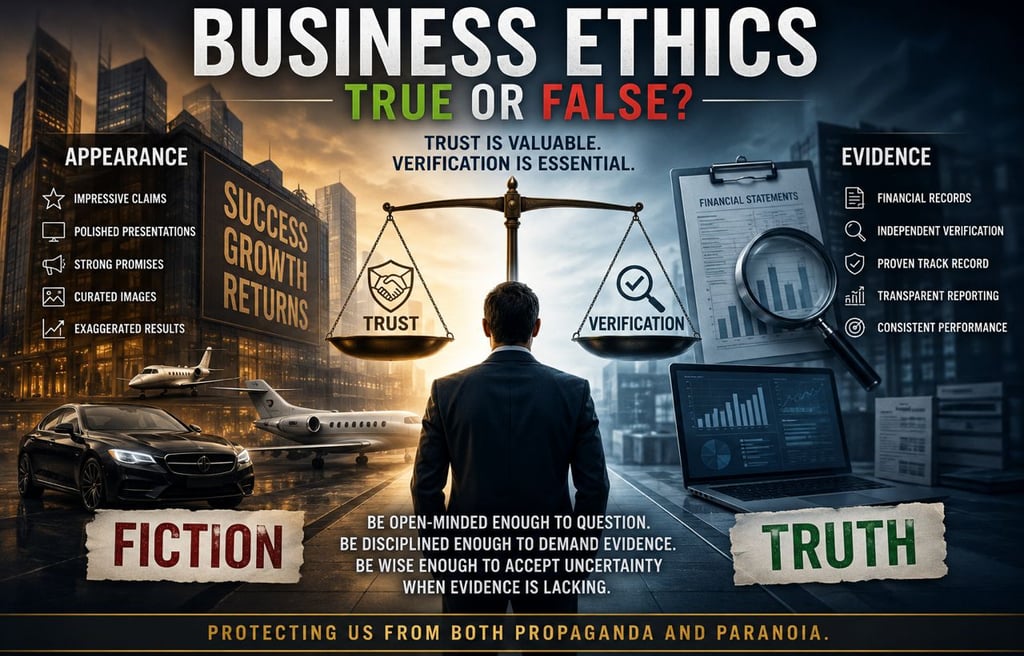
Trust Is Valuable. Verification Is Essential.
An Entrepreneur’s Perspective
One of the greatest misconceptions in business is the belief that trust and verification are opposites.
They are not.
In reality, the strongest business relationships are built upon both.
Whether one is dealing with a multinational corporation, a family office, a government-linked entity, a financial institution, a charitable organisation, or a private entrepreneur, the same principle applies:
Trust is valuable.
Verification is essential.
Yet despite this seemingly obvious truth, countless business failures, investment losses, commercial disputes and broken partnerships continue to occur because individuals choose one extreme over the other.
Some trust too easily.
Others trust nobody.
Both positions are dangerous.
The entrepreneur who trusts blindly may become a victim of deception.
The entrepreneur who trusts nobody may become isolated from opportunity.
The challenge therefore is not deciding whether to trust.
The challenge is learning when trust should be earned and how verification should be applied.
The Modern Business Environment
We live in an era where information has never been more accessible.
Unfortunately, misinformation has never been more accessible either.
Corporate websites look impressive.
Social media profiles appear successful.
Professional biographies can be carefully curated.
Photographs can be manipulated.
Achievements can be exaggerated.
Financial performance can be selectively presented.
References can be manufactured.
In many cases, perception has become easier to create than reality itself.
This does not mean that everyone is dishonest.
Far from it.
Most business owners are hardworking individuals genuinely attempting to build something meaningful.
However, the reality remains that appearances alone are no longer sufficient evidence of credibility.
This is why professional investors, banks, family offices and institutional stakeholders increasingly rely upon due diligence rather than assumptions.
They understand a simple truth: Confidence should be supported by evidence.
The Entrepreneur’s Dilemma
Entrepreneurs often become frustrated when potential investors ask difficult questions.
They may interpret extensive due diligence as distrust.
They may feel offended when financial records are requested.
They may wonder why years of hard work are being scrutinised.
The answer is simple.
Capital is built upon confidence.
Confidence is built upon evidence.
Evidence is built upon verification.
A genuine investor is not attempting to insult an entrepreneur.
A genuine investor is attempting to protect capital.
Likewise, a genuine entrepreneur should not fear reasonable scrutiny.
In fact, professional entrepreneurs should welcome it.
Verification allows legitimate businesses to distinguish themselves from those that merely make promises.
The stronger the business, the easier verification becomes.
The Cost of Blind Belief
History is filled with examples of individuals, corporations and governments that accepted claims without sufficient verification.
Some lost money.
Some lost reputations.
Some lost entire organisations.
The common factor is rarely intelligence.
Many highly intelligent people have been deceived.
Rather, the common factor is often emotional bias.
People tend to believe what they want to believe.
Investors want extraordinary returns.
Entrepreneurs want immediate funding.
Governments want economic growth.
Corporations want strategic advantages.
When desire becomes stronger than discipline, verification often becomes an afterthought.
That is usually when problems begin.
The Cost of Blind Skepticism
The opposite extreme is equally dangerous.
There are individuals who reject every opportunity because they assume every opportunity is fraudulent.
There are investors who miss legitimate opportunities because they become paralysed by suspicion.
There are entrepreneurs who refuse partnerships because they assume hidden motives exist behind every conversation.
Such individuals often mistake cynicism for wisdom.
They are not the same thing.
Wisdom requires critical thinking.
Cynicism requires only disbelief.
One protects opportunity.
The other often destroys it.
The objective should never be to assume everyone is lying.
The objective should be to verify what is being presented.
Governance as a Competitive Advantage
One of the most overlooked realities in business is that governance is not merely a compliance exercise.
It is a competitive advantage.
Businesses that maintain proper records, transparent reporting, documented procedures, professional governance frameworks and verifiable operational histories are significantly more attractive to investors than businesses that rely solely upon promises.
Good governance reduces uncertainty.
Reduced uncertainty increases confidence.
Increased confidence attracts capital.
This principle applies equally to start-ups, SMEs, large corporations and even governments.
Trust may open the door.
Governance keeps it open.
The Reality of Uncertainty
One of the most mature lessons any entrepreneur can learn is that not every question has an immediate answer.
Not every claim can be fully verified.
Not every risk can be eliminated.
Business decisions are often made with incomplete information.
This reality makes many people uncomfortable.
Yet uncertainty is not a weakness.
It is an unavoidable characteristic of entrepreneurship itself.
Every entrepreneur who launches a company, enters a new market, develops a new product or seeks investor capital is making decisions despite uncertainty.
The goal therefore is not to eliminate uncertainty.
The goal is to reduce uncertainty to an acceptable and manageable level.
That is precisely where professional due diligence, governance and verification become valuable.
Truth, Fiction and Everything In Between
The title of this series asks an important question: Business Ethics – Truth or Fiction?
The answer is neither simple nor absolute.
Ethics are real.
Integrity is real.
Professionalism is real.
Unfortunately, so too are deception, manipulation and misrepresentation.
The business world contains both.
Which is why entrepreneurs must develop the ability to distinguish substance from appearance.
This requires more than intelligence.
It requires discipline.
It requires patience.
It requires verification.
Most importantly, it requires the courage to follow evidence wherever it leads, even when the conclusions challenge our assumptions.
Final Reflections
Perhaps the healthiest position is neither blind belief nor blind skepticism.
Instead:
Be open-minded enough to question.
Be disciplined enough to demand evidence.
Be wise enough to accept uncertainty when evidence is lacking.
This approach protects us from both propaganda and paranoia.
It allows entrepreneurs to remain optimistic without becoming naïve.
It allows investors to remain cautious without becoming cynical.
Most importantly, it creates a foundation upon which genuine trust can be built.
Because in business, as in life, trust remains one of the most valuable assets we possess.
But trust becomes truly powerful only when it is supported by verification.
“Trust may start a conversation. Verification determines whether that conversation becomes a partnership. In a world increasingly shaped by perception, evidence remains the ultimate currency of credibility.”
- Dr. Zarif Menon
Contact
Phone
admin@zarifmenon.com
admin@pacificalliancegroup.my
+44 7888 438570 (UK)
+60 16 666 7898 (Malaysia)
+62 877 7999 7898 (Indonesia)
© 2026. All rights reserved.