Why Every Business Needs a 6R Practitioner
Dr. Zarif Menon explains why lasting success comes from redesigning organisations—not simply raising more capital.
Dr Zarif Menon
7/7/20265 min read
There Is One Question I Have Been Asked Throughout My Career…
After more than two decades working with entrepreneurs, family businesses, government agencies, multinational corporations and investors across several countries, one question has remained remarkably consistent.
“Dr. Zarif, what is the first thing you look at when you enter a business?”
Many people assume the answer is financial statements.
Others believe it is management.
Some think it is the product.
The truth is…
I rarely begin with any of those.
I begin by understanding what the business has become… compared to what it was originally intended to be.
Every successful business eventually reaches a point where growth slows.
Margins decline.
Cash flow becomes unpredictable.
Operations become complicated.
Decision making becomes emotional rather than strategic.
Owners begin working harder while earning less.
Ironically, most businesses do not collapse because they lack opportunity.
They collapse because nobody stepped back to redesign the business.
That is precisely why I have always believed in what I refer to as the 6R Practitioner Philosophy.
It is one of the most practical frameworks I have ever used when helping organisations rediscover growth, profitability and sustainability.
What Exactly Is A 6R Practitioner?
A 6R Practitioner is not simply a consultant.
Neither is he merely a financial adviser.
Nor is he just a business coach.
A genuine 6R Practitioner is someone capable of looking at an organisation from multiple perspectives simultaneously.
He studies:
Governance
Operations
Financial Structure
Human Capital
Risk
Strategy
Funding
Market Position
Leadership
Long-Term Sustainability
before recommending any solution.
The objective is not to repair symptoms.
The objective is to restore organisational health.
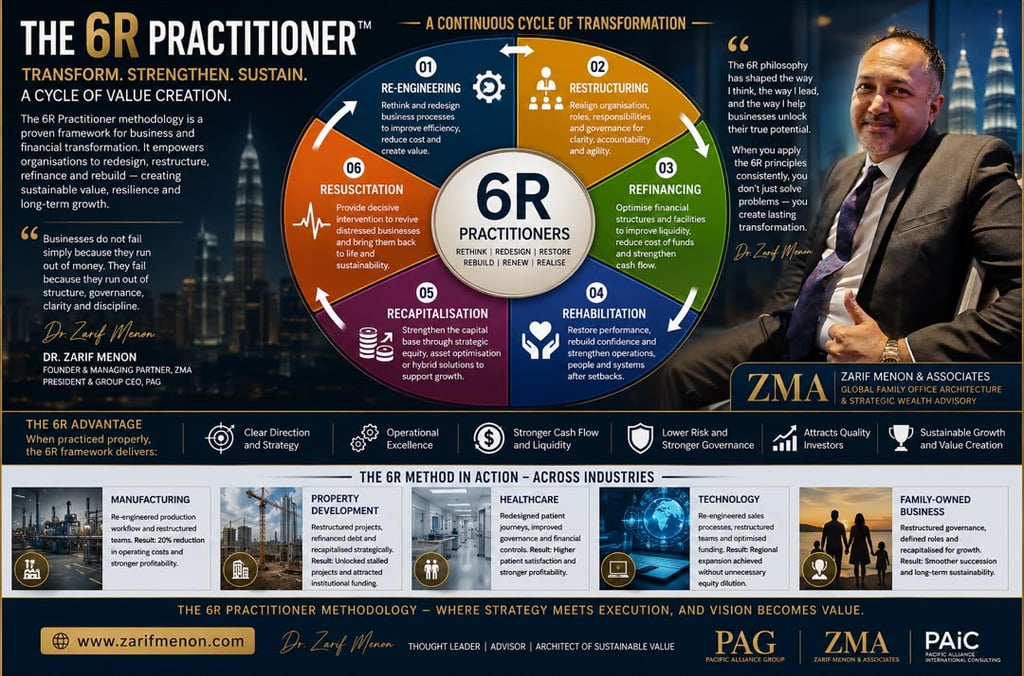
The Six “R’s”
Each stage supports the next.
Together they create a continuous cycle of improvement.
1. Re-engineering
Everything begins here.
Most businesses operate using systems they designed years ago.
The market has changed.
Technology has changed.
Customer expectations have changed.
Yet the business continues operating exactly the same way.
Re-engineering asks difficult questions.
Why are we doing this?
Can this process be simplified?
Can automation improve efficiency?
Can duplication be eliminated?
Can management become leaner?
Sometimes improving profits has nothing to do with increasing sales.
Sometimes it simply requires eliminating unnecessary complexity.
One manufacturing client reduced operating expenses by nearly 20% simply by redesigning workflow rather than increasing production.
2. Restructuring
Once operations have been redesigned…
The organisation itself often requires restructuring.
This may involve:
management responsibilities
reporting lines
ownership structure
governance framework
legal entities
decision-making authority
Many businesses become trapped because too many people are making too many decisions without accountability.
Good restructuring restores clarity.
Everyone knows their role.
Everyone knows their responsibility.
Everyone knows who makes final decisions.
The business becomes faster.
3. Refinancing
This is perhaps the area most entrepreneurs misunderstand.
When business owners hear the word funding… they immediately think: “I need more money.”
Often… they simply need better money.
Refinancing is about improving the quality of capital.
Examples include: Replacing expensive debt.
Consolidating multiple facilities.
Extending repayment tenure.
Reducing financing costs.
Improving cash flow.
Aligning finance with business growth.
The objective is not borrowing more.
The objective is borrowing smarter.
4. Rehabilitation
Every organisation experiences setbacks.
Markets change.
Projects fail.
Key staff resign.
Economic downturns happen.
Poor decisions are made.
Rehabilitation focuses on rebuilding confidence.
Not only financially… but culturally.
This often involves:
rebuilding staff morale
rebuilding customer confidence
rebuilding operational discipline
rebuilding governance
rebuilding market credibility
A rehabilitated organisation becomes stronger because it has learned from failure rather than hiding from it.
5. Recapitalisation
Many businesses possess valuable assets… but very little working capital.
Others possess healthy revenues… but poor balance sheets.
Recapitalisation examines how capital itself is structured.
Should equity be introduced?
Should strategic investors participate?
Should dormant assets be monetised?
Should shareholders restructure ownership?
Should hybrid funding be considered?
This is where governance becomes critically important.
At ZMA, we frequently remind clients: Raising capital is easy.
Maintaining investor confidence is the difficult part. Good governance makes that possible.
6. Resuscitation
This is the final stage.
Sometimes businesses arrive when they are already in distress.
Creditors are waiting.
Suppliers have stopped deliveries.
Banks have become cautious.
Cash flow has almost disappeared.
This is where decisive leadership matters.
Resuscitation is about restoring life.
Sometimes it requires difficult decisions.
Sometimes emotional decisions.
Sometimes unpopular decisions.
But businesses cannot survive on optimism alone.
They survive through disciplined execution.
The Hidden Power Of The 6R Framework
What makes the framework unique is that none of the six components operate independently.
Each strengthens the next.
Better engineering improves restructuring.
Better restructuring improves financing.
Better financing accelerates rehabilitation.
Better rehabilitation supports recapitalisation.
Better recapitalisation enables long-term sustainability.
It becomes a continuous improvement cycle.
Exactly as illustrated in the diagram.
What The 6R Method Has Taught Me Personally
Looking back over my own career…
I now realise that the 6R philosophy shaped my thinking long before I ever consciously described it.
Whether advising multinational corporations…
family offices…
government-linked organisations…
or privately owned SMEs…
I found myself repeatedly asking the same questions.
How can this business operate better?
How can risk be reduced?
How can governance be strengthened?
How can funding become more efficient?
How can owners create long-term value rather than short-term profit?
Over time, I discovered something remarkable.
The businesses that embraced these principles consistently performed better than those searching for quick fixes.
The 6R philosophy transformed not only the businesses I advised…
It transformed the way I think. It taught me patience.
It taught me discipline.
It taught me that sustainable growth is never accidental.
It is designed.
Five Practical Examples
Manufacturing
A factory struggling with rising production costs undertook a full operational review.
After re-engineering workflows and restructuring supervisory roles, production increased while overtime costs declined.
The business required less financing because operational efficiency generated stronger cash flow.
Property Development
A developer facing stalled projects did not need another investor immediately.
The first priority was restructuring project governance, refinancing existing facilities and rehabilitating stakeholder confidence.
Only then did recapitalisation attract institutional funding.
Healthcare
A growing private healthcare group had excellent doctors but weak administration.
Applying the 6R methodology led to redesigned patient workflows, improved governance, better cash collection systems and stronger financial controls.
Patient satisfaction improved alongside profitability.
Technology Company
A software company possessed an excellent product but poor commercial execution.
Re-engineering sales processes, restructuring management accountability and refinancing working capital allowed the company to expand into regional markets without sacrificing equity prematurely.
Family-Owned SME
Perhaps the most common example.
The founder controlled every decision.
Growth had stalled.
Through restructuring governance, defining executive responsibilities and recapitalising strategically, the second generation assumed leadership successfully while preserving family harmony.
Why Fund Raising Is Only One Piece Of The Puzzle
Throughout my advisory career, I have observed one recurring misconception.
Many entrepreneurs believe investors invest in businesses.
In reality…
Professional investors invest in well-governed businesses.
Capital follows confidence.
Confidence follows governance.
Governance follows structure.
Structure follows disciplined thinking.
The 6R framework creates that discipline.
By the time a business reaches the fundraising stage, it should already have re-engineered its operations, restructured its organisation, refined its financing strategy, rehabilitated its performance where necessary, and recapitalised appropriately.
Fundraising then becomes a natural progression—not an act of desperation.
Final Reflections
If there is one lesson my career has reinforced, it is this:
Businesses do not fail simply because they run out of money.
More often, they fail because they run out of structure, governance, clarity and disciplined execution.
The 6R Practitioner philosophy reminds us that transformation is not a single event. It is a continuous journey of questioning, refining and improving.
Whether you are leading a multinational corporation, managing a family-owned enterprise or building a young startup, these six principles provide a practical roadmap for sustainable growth.
For me, the 6R methodology is more than a framework—it is a way of thinking. It has shaped how I evaluate opportunities, solve complex problems and guide clients through uncertainty. Time and again, I have witnessed businesses that seemed constrained by circumstance unlock new potential simply because they were willing to rethink the way they operated.
When businesses embrace the discipline of the six R’s, they stop merely reacting to change.
They begin designing their future.
About the Author
Dr. Zarif Menon is the Founder and Managing Partner of Zarif Menon & Associates (ZMA), Founder, President & Group CEO of Pacific Alliance Group (PAG), and an international governance, strategic advisory and family office practitioner. With more than two decades of experience advising entrepreneurs, family businesses, financial institutions and governments across multiple jurisdictions, he specialises in governance, capital structuring, business transformation, strategic growth and cross-border investment advisory. Through his work, Dr. Menon advocates sustainable value creation, ethical leadership and practical governance as the foundation for long-term business success.
Contact
Phone
admin@zarifmenon.com
admin@pacificalliancegroup.my
+44 7888 438570 (UK)
+60 16 666 7898 (Malaysia)
+62 877 7999 7898 (Indonesia)
© 2026. All rights reserved.