What is money laundering?
This piece takes a closer look at money laundering, how illegal funds are disguised as legitimate income, and the methods commonly used to conceal criminal activity.
Dr Zarif Menon
10/28/20222 min read


Money Laundering is a process of converting cash, funds or properly derived from criminal activities to give it to a legitimate appearance. It is a process to clean 'dirty' money in order to disguise its criminal origin.
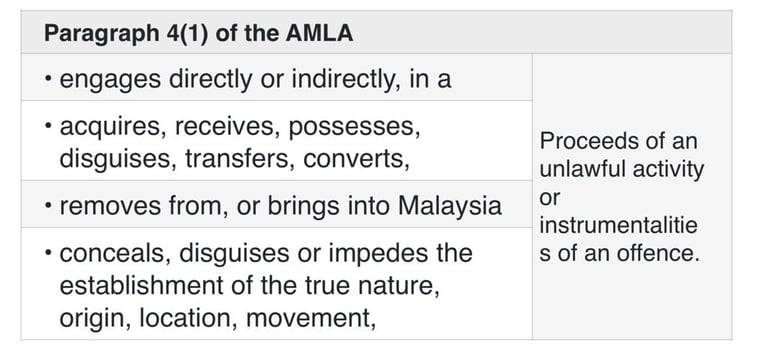
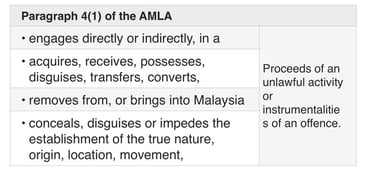
Under the Anti-Money Laundering, Anti-Terrorism Financing and Proceeds of Unlawful Activities Act 2001 (AMLA), a person commits money laundering when the person:
No person shall structure, or direct, assist or participate in structuring, any transaction in domestic or foreign currency, to evade reporting requirement.
How do criminals launder money?
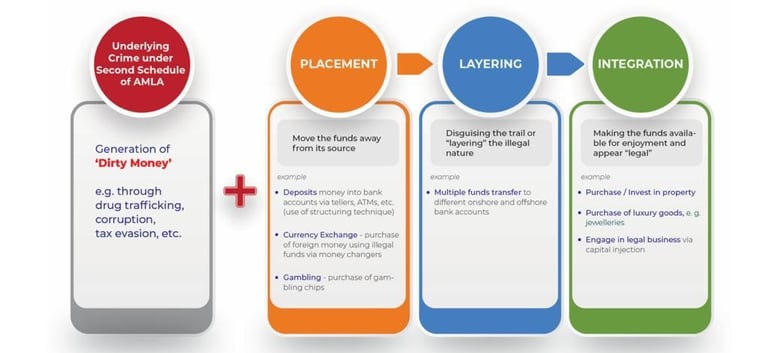
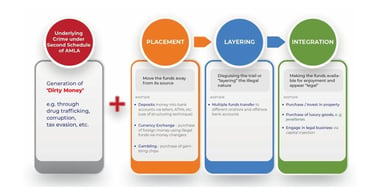
Commonly, there are three stages of the money laundering process: placement, layering and integration.
Placement
Illicit funds are separated from their illegal source. This typically happens when illegal funds are placed into a reporting institution.
Layering
Creating multiple layers of transactions to distance or disguise the illegal funds from their illegal sources. This is to obscure or make it difficult to trace the origin of the illegal funds. This may involve multiple transfers between accounts, hiding funds in shell companies or trusts or transferring funds into multiple assets.
Integration
Final stage where the laundered proceeds are successfully integrated into the economy appearing as legitimate funds. This may include purchases of properties or high value goods, and investment into business ventures.
Money launderers tend to seek out reporting institutions with weak anti-money laundering controls to 'clean' the illegitimate funds through these multiple stages, since there is less risk of detection.
What is anti-money laundering and countering financing of terrorism (AML/CFT)?
AML/CFT refers to any measures to prevent or combat money laundering and terrorism financing. For a country, this may include the laws and regulations that are enacted to prevent criminals from laundering/financing terrorism or, when they launder/finance terrorism, to prosecute them in court.
For reporting institutions, AML/CFT measures may refer to systems or programs, or known as AML/CFT Compliance Program, designed to assist the institutions in preventing themselves from being misused by criminals seeking to launder money through their businesses.
An AML/CFT Compliance Program will cover many areas that help prevent and detect such abuse. The AML/CFT Compliance Program will enable reporting institutions to report potential money laundering or terrorism financing activities to authorities. Collectively, these measures are called 'preventive measures' and the institutions which are designated by law to conduct these measures are called 'reporting institutions'.
The above content and/or article is not the written work of the author and is merely a reproduction of the original article made for the benefit of the general reader. All credits go to AML/CFT and BNM (Anti Money Laundering & Counter Financing of Terrorism Malaysia and Bank Negara Malaysia.
Contact
Phone
admin@zarifmenon.com
admin@pacificalliancegroup.my
+44 7888 438570 (UK)
+60 16 666 7898 (Malaysia)
+62 877 7999 7898 (Indonesia)
© 2026. All rights reserved.