The Hyena's Road
Through allegory and metaphor, The Hyena's Road by Dr Zarif Menon explores how persuasive narratives can shape perceptions, influence decisions, and obscure accountability.
Dr Zarif Menon
6/3/20264 min read
THE HYENA’S ROAD
A Story About Narratives, Promises, and Accountability
There was once a man named Terrence Elridge Nelson (TEN)
To those who first met him, Terrence appeared charming, knowledgeable, and remarkably persuasive.
He always seemed to know important people.
He always had access to extraordinary opportunities.
He always spoke with certainty.
And most importantly, he always had a story.
For years, Terrence travelled from company to company introducing investors, business owners, consultants, and associates to what he called “the opportunity of a lifetime.”
Among those he convinced was a respected consultant named Zavier Monroe, who operated a small advisory firm called Zavier Monroe Advisory (ZMA).
Terrence introduced Zavier to a wealthy political family from a distant island nation.
He claimed they controlled enormous financial resources and possessed the ability to unlock funding that would transform businesses throughout the region.
The story sounded impressive.
The introductions appeared genuine.
The meetings took place.
The promises were made.
And so the journey began with Zavier’s blind trust in Terrence.
Building The Road
At first, everyone believed they were travelling towards a destination.
Business owners committed time.
Consultants invested resources.
Associates contributed effort.
Some even advanced funds to support meetings, travel, documentation, and operational expenses.
Whenever questions arose, Terrence had answers.
Whenever delays occurred, Terrence had explanations.
Whenever deadlines passed, Terrence had new timelines.
The road always continued.
And everyone continued driving.
The First Detour
Months became a year.
The promised destination remained somewhere over the horizon.
Whenever someone questioned the route, Terrence would point forward, with an angry tone.
“We are almost there.”
“The paperwork is nearly complete.”
“The approvals are being processed.”
“The principals are travelling.”
“The banks need more time.”
“The lawyers are reviewing.”
“There is one final hurdle.”
Then another. And another. And another. Yet somehow, the destination never appeared.
The Toll Booths
Along the road, there were toll booths.
Small payments here.
Administrative costs there.
Travel expenses.
Meetings.
Compliance.
Consultants.
Facilitators.
Introducers.
Advisors.
None of the amounts seemed unreasonable individually, because it was all funded by Zavier and ZMA. (Including personal costs and expenses related to Terrence)
But collectively, the road became very expensive.
Still, everyone continued because Terrence always promised that success was just around the next bend.
The Cracks Begin To Show
Eventually, some travellers began comparing notes.
Questions became harder to answer.
Timelines became harder to justify.
Documents became harder to verify.
Promises became harder to believe.
The road ahead started looking increasingly damaged.
Then one day the travellers realised something alarming.
The road was no longer leading anywhere.
It simply ended.
The bridge ahead had collapsed.
There was nowhere left to drive.
No further extensions.
No further explanations.
No further excuses.
Only a dead end.
The Abandonment
And that was when Terrence did something extraordinary.
After months of leading the convoy, he climbed out of the driver’s seat and declared:
“I was never driving.”
When the travellers looked at him in disbelief, he continued:
“There was never an agreement.”
“I was merely helping.”
“I was only following instructions.”
“I am not responsible.”
“It was all someone else’s idea.”
The very people he had introduced, promoted, defended, and encouraged others to trust suddenly became strangers.
The opportunities he had championed suddenly became someone else’s responsibility.
The road he had spent months directing everyone down suddenly became a road he claimed he had never travelled.
The New Story
But Terrence was not finished.
Because people who survive through narratives understand one important truth:
When reality becomes impossible to defend, create a new story.
And so a new story emerged.
The consultant firm became the villains.
The advisor became the villain.
The associates became the villains.
Anyone who refused to support the new narrative became part of the conspiracy.
Even those who had once trusted Terrence became targets if they declined to support his version of events.
The goal was simple.
Redirect attention.
Create confusion.
Rewrite history.
And hope nobody remembered who built the road in the first place.
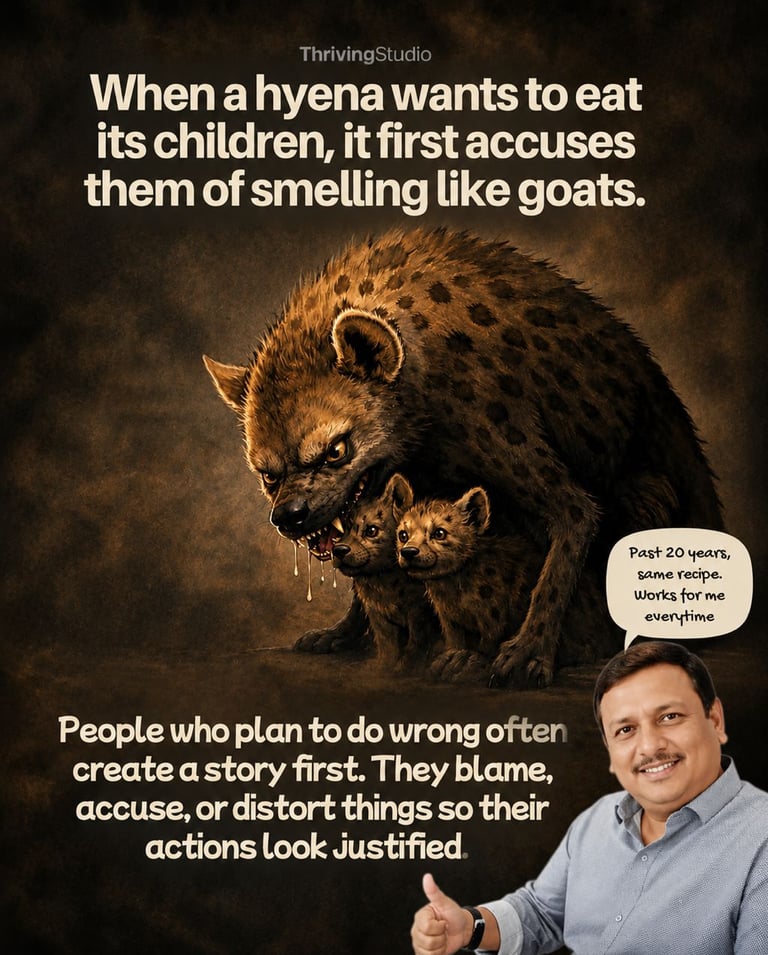
The Hyena
There is an old saying:
“When a hyena wants to eat its children, it first accuses them of smelling like goats.”
The wisdom behind the saying is timeless.
Before wrongdoing can be justified, a justification must first be created.
Before blame can be transferred, a narrative must first be constructed.
Before responsibility can be escaped, someone else must be identified as responsible.
The accusation comes first.
The evidence comes later.
Or sometimes never.
The Difference Between Mistakes and Manipulation
Everyone makes mistakes.
Projects fail.
Deals collapse.
Markets change.
Investors withdraw.
These things happen.
But there is a difference between failure and manipulation.
Failure accepts responsibility.
Manipulation creates a scapegoat.
Failure seeks solutions.
Manipulation seeks excuses.
Failure learns.
Manipulation rewrites history.
The Travellers Lesson
The travellers eventually learned something valuable.
The most dangerous road is not the one filled with obstacles.
The most dangerous road is the one built entirely on promises.
Because when a road is made from promises rather than facts, it can continue forever.
Until one day it simply ends.
And when it does, the architect often disappears while everyone else is left trying to find their way home.
Moral Of The Story
The cleverest deceivers rarely steal with their hands.
They steal with stories.
They create narratives.
They manufacture confusion.
They delay accountability.
And when the truth finally catches up, they point in every direction except the mirror.
Always remember:
Those who consistently create villains around them may eventually reveal who the true villain was all along.
And whenever someone spends more time explaining why everyone else is responsible than explaining their own role in the matter…
look carefully at who built the road.
Because the person pointing at others is not always the person leading you forward.
Sometimes, he is simply trying to distract you from the dead end ahead.
“The greatest con is not convincing people to believe a lie. It is convincing them to distrust the truth when it finally arrives.”
Contact
Phone
admin@zarifmenon.com
admin@pacificalliancegroup.my
+44 7888 438570 (UK)
+60 16 666 7898 (Malaysia)
+62 877 7999 7898 (Indonesia)
© 2026. All rights reserved.